

NCAA, NAIA, NJCAA… You hear these acronyms everywhere, but you don’t know exactly what they mean? You are not alone. 90% of the French athletes who contact us do not know the difference between these leagues. Yet choosing the wrong one can cost you tens of thousands of dollars in scholarship money. This guide explains everything, division by division, so you can make the right choice from the start.
In this guide, you will discover: what each acronym means, how many athletic scholarships each league offers, what athletic level is required, the advantages and disadvantages of each division, and how to know which one matches your profile.
🎓 EVALUATE YOUR PROFILE FOR FREE →
NCAA, NAIA, NJCAA: what exactly are they?
American college sports are organized by three major associations, each bringing together hundreds of universities with their own rules, scholarship budgets and athletic levels. These are not professional leagues: they are organizations that govern sports played by students as part of their studies.
The NCAA (National Collegiate Athletic Association)
The NCAA is the most well-known and prestigious organization. Founded in 1906, it now includes around 1,100 universities divided into three divisions (D1, D2, D3). It organizes March Madness, Bowl Games and most college competitions broadcast on American television. It sets eligibility rules, scholarship budgets and schedules for each sport.
The NAIA (National Association of Intercollegiate Athletics)
The NAIA includes around 250 universities, generally smaller and often more human-sized. Less publicized than the NCAA, it nevertheless offers very competitive athletic scholarships, sometimes higher than NCAA D2, with more flexible eligibility rules. It is a strategic option often underestimated by French athletes.
The NJCAA (National Junior College Athletic Association)
The NJCAA includes around 500 two-year institutions (Junior Colleges or Community Colleges). It does not award a Bachelor’s degree (4-year degree), but an Associate Degree after 2 years, before transferring to an NCAA or NAIA university. It is often the smartest strategic stepping stone for profiles who need to improve athletically or academically before joining a major university.
What is the difference between NCAA Division I, II and III?
Within the NCAA, the three divisions are not simply a matter of prestige. They differ in the required athletic level, available scholarship budgets, and the balance between sports and academics. Choosing the right division is just as important as choosing the right university.
NCAA Division I (D1): the top level of American college sports
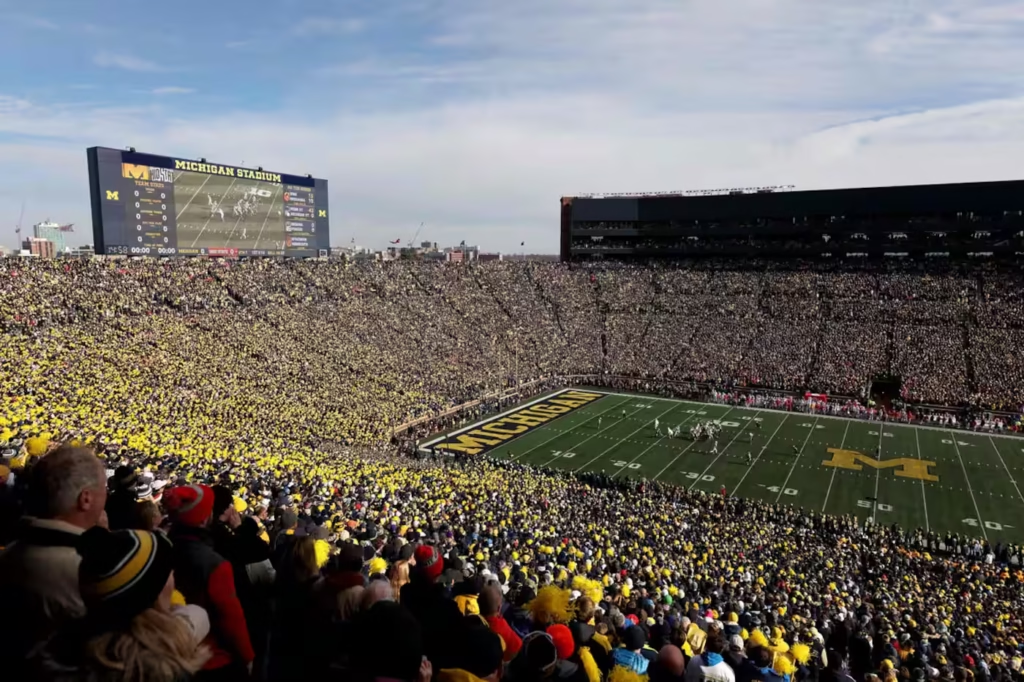
Division I includes around 350 universities and represents the highest level of college sports, equivalent to a semi-professional level in certain sports such as basketball or American football. The facilities, coaches and development programs are of a very high standard.
- Required athletic level: Very high
- Athletic scholarships: Full (100%) or partial depending on the sport and university
- Training load: Intensive, around 20 hours/week minimum outside competition
- Examples of universities: UCLA, Duke University, University of Florida, Stanford, Texas A&M
- Ideal for: Athletes with an elite profile and professional ambitions in their sport
ProcessUS advice: Do not only target the most famous D1 universities (Stanford, Duke…). Second-tier D1 programs offer scholarships that are just as generous (sometimes more) with an athletic level accessible to many French athletes competing at national level.
NCAA Division II (D2): the perfect balance between sports and academics
Division II includes around 300 universities. It is often the best choice for athletes who want a high athletic level and real academic support, without the extreme pressure of D1.
- Required athletic level: Intermediate, solid regional to national level
- Athletic scholarships: Mainly partial, can be combined with academic scholarships
- Atmosphere: More family-oriented, personalized support, more guaranteed playing time
- Examples of universities: University of Tampa, Rollins College, Embry-Riddle, Findlay University
- Ideal for: Athletes who want to progress athletically while earning an excellent degree
NCAA Division III (D3): academics come first
Division III includes around 450 universities, some of which are among the most academically prestigious in the United States. It stands out because of one fundamental rule: no athletic scholarships are allowed. However, academic scholarships (merit scholarships) are often very generous.
- Athletic scholarships: Prohibited by NCAA D3 regulations
- Academic scholarships: Available and often very high
- Athletic level: Competitive but less intensive than in D1 or D2
- Examples of universities: MIT, Emory University, University of Chicago, Williams College
- Ideal for: Athletes with an excellent academic record and a strong academic ambition above all
Warning: Do not cross D3 off your list without checking the available academic scholarships. Some profiles finance their studies through merit scholarships, sometimes more effectively than with a partial athletic scholarship in D2.
What is the difference between the NCAA and the NAIA?
This is the question we receive most often. The NAIA is often seen as a second-tier league, but this is a frequent and costly mistake. For many French athlete profiles, the NAIA is the best available option, with scholarships sometimes higher than NCAA D2.
The 4 major advantages of the NAIA for international athletes
- More flexible eligibility rules
- Often more generous scholarship budgets
- Personalized support
- Less bureaucracy
A degree from an accredited NAIA university is fully recognized in France and Europe, exactly like an NCAA degree. For your future employer, what matters is the quality of the university and the academic program, not the athletic league.
What is the NJCAA? The strategic stepping stone no one explains to you
The NJCAA is the forgotten league in most guides about American athletic scholarships, and yet it represents the smartest strategy for certain profiles. Here is why.
A Junior College means 2 years of study leading to an Associate Degree. At the end of these two years, you transfer to a 4-year NCAA or NAIA university with:
- 2 remaining years of athletic eligibility: exactly as if you entered directly
- A strengthened American academic record: which opens the doors to better universities
- An athletic level developed on American fields/courts, with local coaches
- Already adapted to American life: language, culture, university pace
Average cost of a Junior College: $15,000 to $25,000/year before scholarships, which is much less than a 4-year university.
This strategy is ideal for: athletes with an academic record to improve, an athletic level still in development, a more limited initial budget, or those who simply want to test American college life before committing to 4 years.
NCAA D1 / D2 / D3 / NAIA / NJCAA comparison table: all the differences at a glance
Here is the complete reference table to compare each league. It brings together everything you need to know to guide your choice according to your level, budget and goals.
| Criteria | NCAA D1 | NCAA D2 | NCAA D3 | NAIA | NJCAA |
|---|---|---|---|---|---|
| Number of universities | ~350 | ~300 | ~450 | ~250 | ~500 |
| Athletic scholarship | ✅ Yes | ✅ Yes | ❌ No | ✅ Yes | ✅ Yes |
| Academic scholarship | ✅ Yes | ✅ Yes | ✅ Yes | ✅ Yes | ✅ Yes |
| Required athletic level | Very high | Intermediate | Competitive | Intermediate | Variable |
| Degree duration | 4 years | 4 years | 4 years | 4 years | 2 years |
| Eligibility rules | Strict | Strict | Flexible | Flexible | Very flexible |
| Ideal for | Regional / national champions | Regional / national athletes | Academic priority | Mixed profiles | Strategic stepping stone |
🎯 WHICH LEAGUE IS RIGHT FOR MY PROFILE? LET’S TALK →
How much are athletic scholarships depending on the division?
The amount of a scholarship does not depend only on the division: it varies according to the sport, the university, your level and your academic record.
To learn everything about how to obtain an athletic or academic scholarship, click here.
🎓 ProcessUS takes care of EVERYTHING for you
From the initial evaluation to your arrival on campus (and even after), we manage every step of the process to maximize your chances and the amount of your scholarship. LET’S TALK ABOUT YOUR PROJECT →
📍 ProcessUS Consulting – Cap d’Agde, Hérault, Occitanie
🎾 Tennis: Antoine Le Doré 06 61 93 88 99 | Nathan Schwartz 06 95 42 24 32
🏀 Basketball: Brice Vinson 06 13 95 68 87 | Mélissa Micaletto 06 50 25 45 37
FAQ: your questions about the NCAA, NAIA and NJCAA
Can you transfer from the NAIA to the NCAA during your pathway?
Yes, but strict transfer rules apply. An athlete transferring from the NAIA to NCAA D1 generally has to complete a sit-out year (without competition), except in certain cases. Transfers to NCAA D2 are often more flexible. Each situation is unique, and a prior analysis by an expert helps avoid unpleasant surprises.
Is a degree from a NAIA or NJCAA university recognized in France?
Yes. Bachelor’s degrees (4 years) from accredited NAIA universities are fully recognized in France and Europe, equivalent to a Bachelor’s degree plus the beginning of a Master’s degree. The NJCAA Associate Degree (2 years) is not a final degree: it serves as a stepping stone before your Bachelor’s degree at a 4-year university. French employers highly value bilingualism and international experience, regardless of your university’s athletic league.
Can you combine an athletic scholarship and an academic scholarship?
Yes, absolutely, and this is the strategy ProcessUS systematically recommends. Athletic scholarships and academic scholarships (merit scholarships) can be combined in all divisions except D3, where only academic scholarships exist.
Choosing your NCAA, NAIA or NJCAA division starts now
There is no universal answer to the question “which division should I choose?” The right league depends on your current athletic level, your academic ambition, your sport, your budget and when you want to leave. That is exactly why ProcessUS carries out a free personalized analysis for every athlete before proposing any strategy.
Whether you are ranked 0 in tennis, a Nationale 2 basketball player, a CFA football player, or an athlete in any sport, there are scholarship opportunities adapted to your profile in NCAA D1, D2, NAIA or NJCAA. Our role is to find which one, and to get you there.
🎓 Ready to discover which division matches you?
Request your free evaluation now EVALUATE MY PROFILE →
📍 ProcessUS Consulting
USA college placement agency – Cap d’Agde, Hérault, Occitanie
🎾 Tennis: Antoine Le Doré 06 61 93 88 99 | Nathan Schwartz 06 95 42 24 32
🏀 Basketball: Brice Vinson 06 13 95 68 87 | Mélissa Micaletto 06 50 25 45 37
✉️ contact@processusconsulting.com
🌐 www.processusconsulting.com
Page updated in May 2026 | ProcessUS Consulting – USA college placement expert since 2018